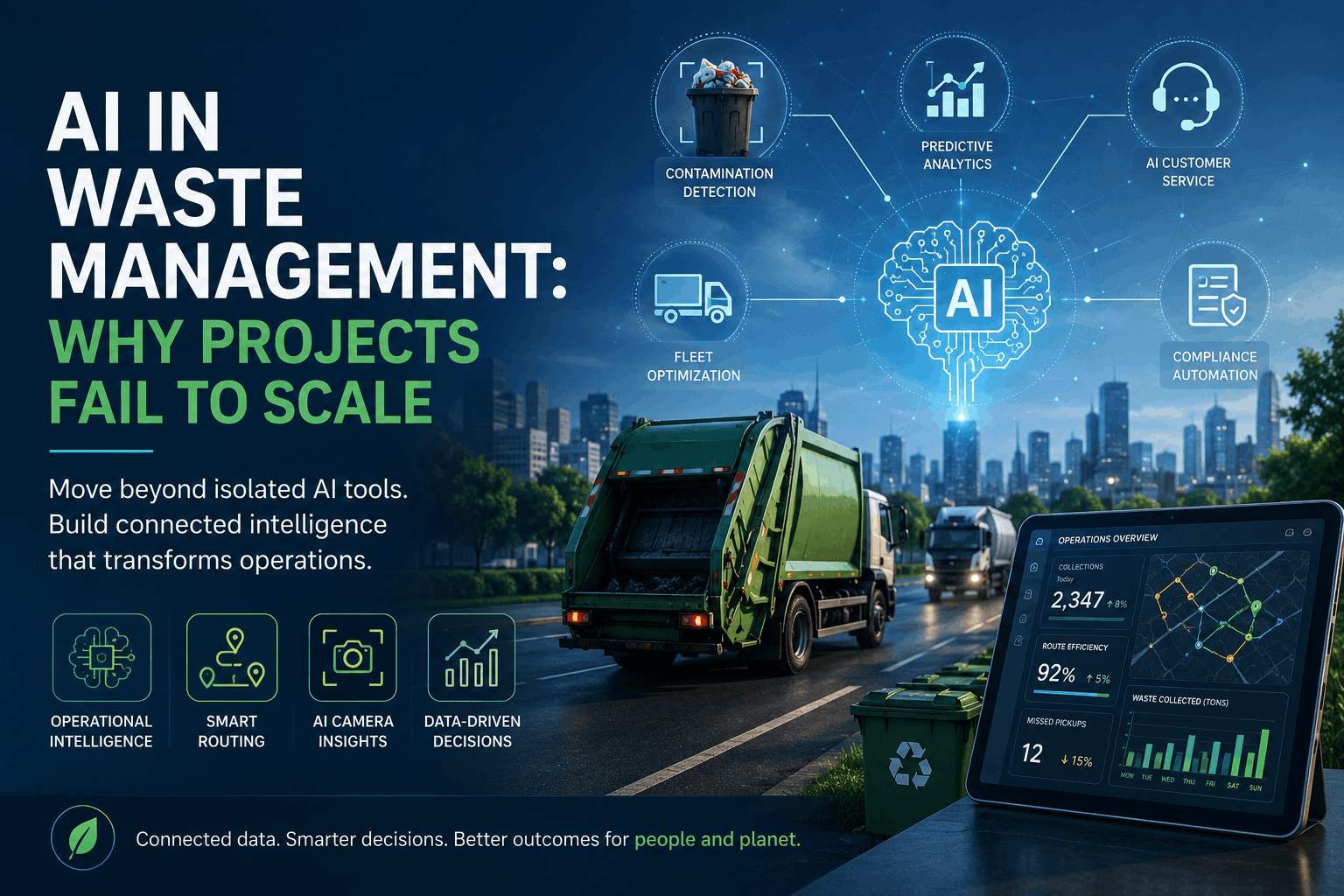
Artificial intelligence is transforming the waste and recycling industry faster than ever. AI in waste management appears in every step: AI cameras identify contamination, virtual assistants resolve customer inquiries around the clock, predictive analytics optimize collection routes, and machine learning helps facilities improve material recovery.
Yet despite this rapid adoption, many waste and recycling companies struggle to generate long-term operational value from their AI investments.
The issue is this: many organizations implement AI in waste management as a collection of independent tools instead of building an intelligent, connected operation.
According to McKinsey’s 2025 State of AI report, while AI adoption continues to rise across industries, relatively few organizations have successfully scaled AI to create enterprise-wide value. Companies achieving the highest returns are those that redesign workflows rather than simply deploying new AI applications. This distinction is especially important in waste management, where every operational decision influences multiple teams, systems, and stakeholders.
For waste operators, AI should do more than automate individual tasks. It should enable better decisions across the entire operation. But how?
AI Isn’t the Goal, Better Waste Operations Are
Many organizations begin their AI journey with a specific operational challenge.
Perhaps they want to improve contamination detection using AI-powered cameras. Others invest in AI customer service to reduce call volumes or use predictive analytics to optimize collection routes. Each initiative delivers measurable improvements within its own scope.
However, waste management isn’t made up of isolated processes.
Every missed pickup affects customer satisfaction. Every contamination event impacts recycling quality. Every vehicle breakdown disrupts collection schedules. Compliance updates influence reporting, documentation, and service delivery simultaneously.
When AI solutions operate independently, employees become responsible for connecting the dots between systems. Instead of eliminating operational complexity, organizations simply automate isolated activities while maintaining manual workflows behind the scenes.
The objective should be building smarter waste operations.
Why Standalone AI in Waste Management Solutions Creates New Operational Silos
Ironically, AI investments can create new silos instead of eliminating existing ones.
Every AI application generates valuable operational data. An AI camera identifies contamination. A routing engine recommends a more efficient collection pCreatesath. An AI call assistant records customer complaints.
But what happens next?
If these insights remain trapped inside separate platforms, dispatch teams, customer service representatives, compliance managers, and operations planners still need to manually transfer information between systems.
The result is another dashboard.
This challenge isn’t unique to waste management. According to Deloitte’s State of Generative AI report, more than two-thirds of organizations expect 30% or fewer of their generative AI experiments to successfully scale into production within the next three to six months. Moving beyond successful pilots remains one of the biggest barriers to realizing AI’s full value.
For waste and recycling companies, disconnected systems make that challenge even greater.
Waste Operations Demand Connected Intelligence with AI in Waste Management
Unlike many industries, waste and recycling operations involve thousands of interconnected decisions every day.
Collection vehicles move continuously across municipalities. Drivers adapt to changing road conditions. Recycling facilities manage fluctuating material volumes. Customer and citizen requests arrive throughout the day, while environmental regulations continue evolving.
At the same time, operational complexity is increasing worldwide. As waste volumes grow, operators cannot rely on disconnected software or manual coordination to maintain efficiency.
This is why AI for waste management must understand operational relationships rather than individual events.
A contamination alert isn’t simply an image.
It’s a customer interaction, a compliance record, a collection event, and potentially a billing or service issue, all at the same time.
From AI Alerts to Operational Intelligence
The real value of AI doesn’t come from producing more notifications.
It comes from enabling the next operational decision automatically.
Imagine an AI camera detects contamination during collection.
Rather than simply storing an image, an intelligent waste management platform could automatically:
identify the customer account,
update collection records,
notify customer service,
create a digital audit trail,
recommend follow-up actions,
trigger compliance documentation,
provide operational insights for future route planning.
Instead of asking multiple employees to coordinate these tasks across different systems, AI orchestrates the workflow as one connected process.
This is the difference between AI workflow automationand operational intelligence.
What High-Performing Companies Do Differently with AI in Waste Management?
Organizations achieving meaningful results from waste management AI don’t simply invest in more AI applications.
They connect intelligence across the entire operation.
Rather than treating AI cameras, fleet optimization, customer service automation, compliance management, reporting, and route planning as separate initiatives, they create one operational ecosystem where information flows continuously between systems.
This connected approach allows every operational event to improve future decisions.
A missed pickup informs customer communications.
A contamination incident influences recycling performance reporting.
Instead of isolated automation, AI becomes part of everyday operational decision-making.
Building an AI-Ready Waste Management Strategy
Before implementing another AI solution, waste operators should evaluate the maturity of their operational workflows.
Key questions include:
Can operational data move seamlessly across departments?
Does one operational event automatically trigger the next action?
Are fleet management, customer service, compliance, and reporting connected?
Can AI recommend decisions, not simply generate alerts?
Is your waste management software designed to support operational intelligence?
Answering these questions often reveals that the greatest opportunities don’t exist within individual processes; they exist between them.
As McKinsey notes, organizations create the greatest value from AI when they redesign end-to-end workflows instead of optimizing isolated tasks. That principle is particularly relevant for waste and recycling operations, where every decision influences multiple parts of the business.
The Future of AI in Waste Management Is Connected Operations
Artificial intelligence is already reshaping the waste and recycling industry. But the companies that achieve lasting competitive advantage won’t necessarily be those using the most AI tools.
They will be the ones that connect intelligence across fleets, field operations, customer service, compliance, recycling facilities, and reporting.
According to PwC, AI could contribute up to $15.7 trillion to the global economy by 2030. Much of that value will come not from automating individual tasks, but from transforming how organizations operate.
The future of AI in waste management isn’t about adding another dashboard or another standalone application.
It’s about creating an intelligent operating model where every piece of operational data contributes to faster decisions, better service, stronger compliance, and continuous improvement.
For waste and recycling companies, AI delivers its greatest value when every system and every decision works together. That is the foundation of scalable, intelligent, and future-ready waste operations.
Turn Disconnected Data into Decisive Action with Evreka AI in Waste Management
The difference between a costly technology experiment and a highly profitable operation lies in how your systems talk to one another. Evreka replaces isolated databases and chaotic dashboards with a single, coordinated engine. By automatically linking your fleet, customer support, and compliance processes, we ensure that an event in the field instantly triggers the correct response across your entire business. No manual data transfers, no missed details, just a sharper, more efficient operation.
See how it works under the hood.Schedule your demo today to align your teams, eliminate manual workflows, and secure the return on your technology investments.
eBooks
Download most recent e-books from our library now.
We use cookies on our website to give you the most relevant experience by remembering your preferences and repeat visits. By clicking “Accept All”, you consent to the use of ALL the cookies. However, you may visit "Cookie Settings" to provide a controlled consent.
This website uses cookies to improve your experience while you navigate through the website. Out of these, the cookies that are categorized as necessary are stored on your browser as they are essential for the working of basic functionalities of the website. We also use third-party cookies that help us analyze and understand how you use this website. These cookies will be stored in your browser only with your consent. You also have the option to opt-out of these cookies. But opting out of some of these cookies may affect your browsing experience.
Necessary cookies are absolutely essential for the website to function properly. These cookies ensure basic functionalities and security features of the website, anonymously.
Cookie
Duration
Description
cookielawinfo-checkbox-analytics
11 months
This cookie is set by GDPR Cookie Consent plugin. The cookie is used to store the user consent for the cookies in the category "Analytics".
cookielawinfo-checkbox-functional
11 months
The cookie is set by GDPR cookie consent to record the user consent for the cookies in the category "Functional".
cookielawinfo-checkbox-necessary
11 months
This cookie is set by GDPR Cookie Consent plugin. The cookies is used to store the user consent for the cookies in the category "Necessary".
cookielawinfo-checkbox-others
11 months
This cookie is set by GDPR Cookie Consent plugin. The cookie is used to store the user consent for the cookies in the category "Other.
cookielawinfo-checkbox-performance
11 months
This cookie is set by GDPR Cookie Consent plugin. The cookie is used to store the user consent for the cookies in the category "Performance".
viewed_cookie_policy
11 months
The cookie is set by the GDPR Cookie Consent plugin and is used to store whether or not user has consented to the use of cookies. It does not store any personal data.
Functional cookies help to perform certain functionalities like sharing the content of the website on social media platforms, collect feedbacks, and other third-party features.
Performance cookies are used to understand and analyze the key performance indexes of the website which helps in delivering a better user experience for the visitors.
Analytical cookies are used to understand how visitors interact with the website. These cookies help provide information on metrics the number of visitors, bounce rate, traffic source, etc.
Advertisement cookies are used to provide visitors with relevant ads and marketing campaigns. These cookies track visitors across websites and collect information to provide customized ads.