New EU cross-border waste rules are now in force. Try our free platform and get compliant today.


Solutions
Digital Twin
Visualize, test and compare different operational scenarios before you choose between them. Evreka Digital Twin turns your own operational data into a living virtual model, so every decision is backed by evidence instead of a guess.
Any operation runs on hundreds of interacting variables (assets, schedules, workflows, costs), and a single change in one corner can ripple into service levels, timelines and costs elsewhere in ways that are hard to predict from a spreadsheet alone. Evreka Digital Twin models those interactions directly from your own operational history, so you can build a scenario, run it virtually, and see its cost, efficiency and sustainability impact before you commit real resources to it. One scenario moves forward with confidence; the other is ruled out before it costs you anything.
What-ifscenario testing on real operational data
Side-by-sidebaseline vs. scenario comparison
Data-drivendecisions backed by your own history
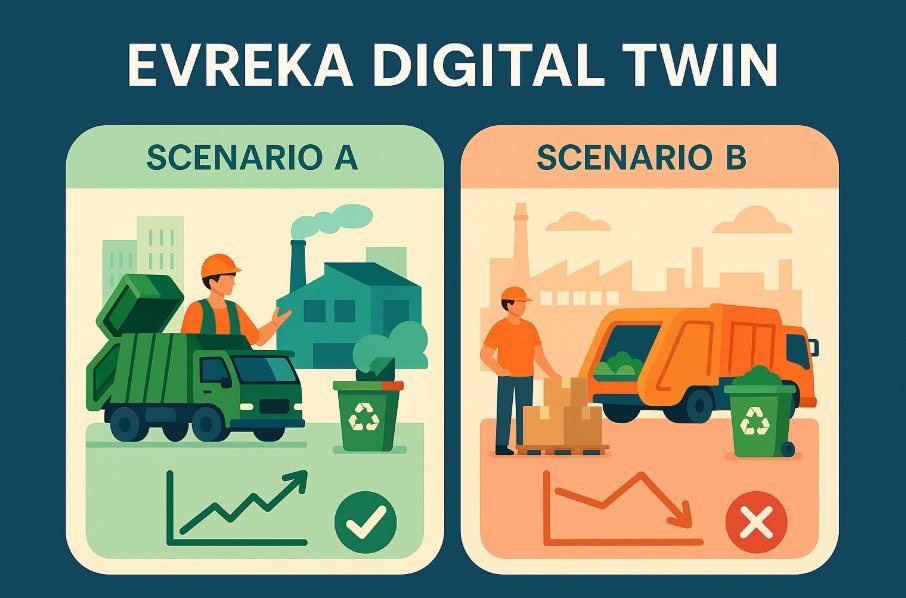
Scenario Visualization
See each path before you pick one
Model a change as a scenario, visualize its outcome, and compare it against the way things run today.
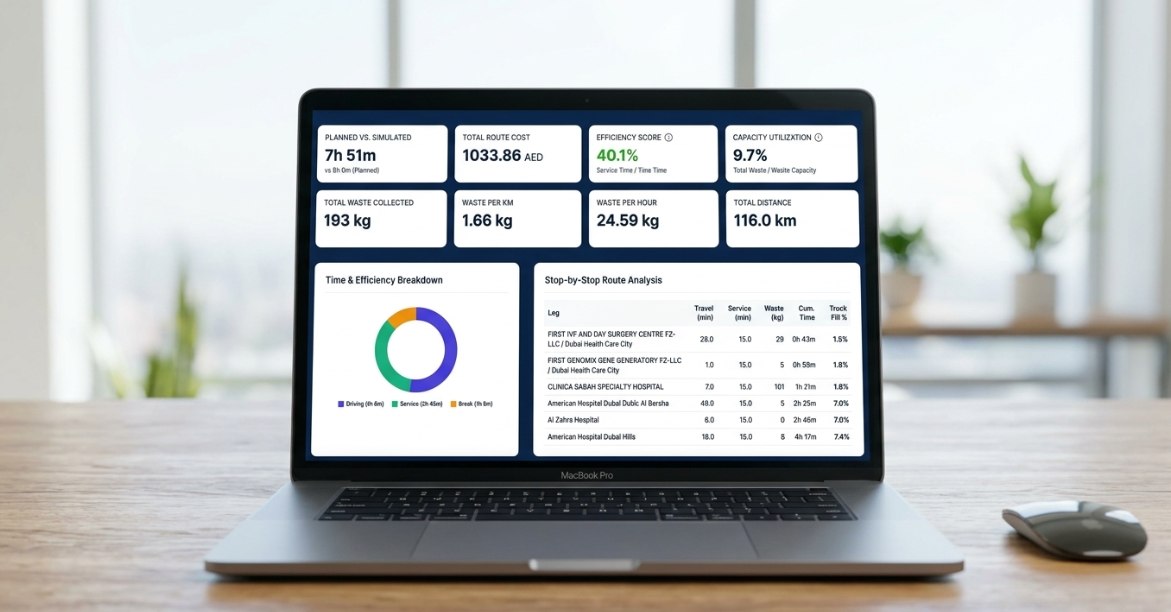
Full Detail
Every detail, captured
Full operational detail down to each step, cost and time, feeding every scenario you build.
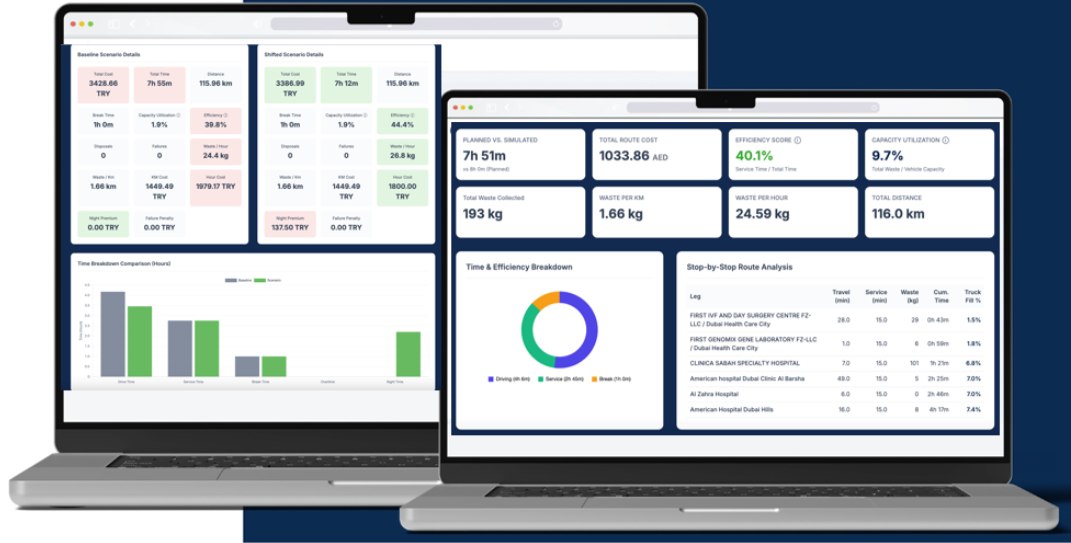
Scenario Comparison
Baseline vs. scenario, side by side
Compare cost, time and efficiency at a glance to see exactly what changed and why.
The Challenge
Managing complexity in daily operations
Most operations run on hundreds of interacting variables, and most organizations still plan around them with spreadsheets, intuition or limited historical data. A single change in one corner of the operation can ripple into service levels, cost and output elsewhere, and without a way to model that ripple effect, the impact is almost impossible to anticipate before it happens.
No way to test before committing
A resourcing or process change is usually decided on paper, then corrected in the field once the real costs and bottlenecks show up.
Digital Twin fix: run the change as a virtual scenario first, and see the cost, time and capacity impact before it touches a single asset.
Spreadsheets can't model ripple effects
A single change in capacity, scheduling or workflow affects cost and output elsewhere in the operation, but static spreadsheets don't show that chain reaction.
Digital Twin fix: simulations model how operational variables interact, so the downstream impact of one change is visible upfront.
Decisions rely on assumptions, not data
Without a way to quantify trade-offs, planning defaults to intuition and past habit rather than evidence from the operation's own performance.
Digital Twin fix: every scenario is built on your own operational data, not generic assumptions.
Field testing is slow, costly and risky
Validating a change by trying it in the real world risks live service disruption if it goes wrong, and weeks of observation before you know either way.
Digital Twin fix: instant virtual what-if analysis instead of real-world field testing, so issues surface before rollout, not after.
These pressures show up differently depending on where you sit in the chain. Waste management operators feel it as unbalanced fleets, unpredictable routes and service levels that are hard to guarantee. Waste producers and manufacturers feel it as on-site collection that's hard to size correctly, and compliance reporting with little visibility into what drives the numbers. Digital Twin is built to answer both. See how under Applications Across The Waste Ecosystem below.
The Solution
Evreka Digital Twin
A virtual model of your operations, built from the data you already capture. Adjust the variables that matter, run the scenario, and see the outcome before you commit resources to it, turning planning from a reactive process into a predictive, data-driven one.
Predictive Planning
Anticipate bottlenecks, plan resources ahead, and prevent inefficiencies before they happen.
Resource Optimization
Achieve higher utilization of your assets, fleets and manpower.
Operational Efficiency
Reduce unnecessary trips, minimize resource usage, and increase throughput.
Strategic Decision Support
Compare investment or process-change scenarios against real operational data.
Sustainability Alignment
Identify the configurations that reduce emissions while improving performance.
Why It Matters
Digital Twin vs. traditional planning
Traditional planning answers "what happened?" A digital twin answers "what will happen if we change this?"
| Dimension | Traditional Planning | Evreka Digital Twin |
|---|---|---|
| Approach | Reactive | Predictive |
| Data source | Historical reports | Live simulation on real operational data |
| Decision method | Assumption-driven | Data-driven |
| Testing speed | Slow, real-world field testing | Instant, virtual what-if analysis |
| Implementation risk | High (issues surface after rollout) | Lower (issues surface before rollout) |
Applications Across The Waste Ecosystem
Built for every role in the waste value chain
Municipalities & Public Authorities
Simulate service coverage, fleet distribution and budget planning by modeling collection frequencies, fleet sizes and shifts before implementing real-world changes, for evidence-based, transparent public operations.
Private Waste Management Companies
Test adding or reallocating vehicles, introducing new waste streams, or outsourcing service zones, and see how route structure and shift timing affect collection time, productivity and profitability.
Recycling & Treatment Facilities
Forecast inbound material flows from changes in collection or segregation strategy, and plan sorting, storage and processing capacity with greater accuracy for stable material inflow.
Waste Producers & Manufacturers
Model on-site waste generation, storage and internal collection workflows, simulating container placement, pickup frequency, segregation setup and workforce scheduling.
FAQ
Common questions
Evreka Digital Twin draws on the operational and material flow data already collected through Evreka360 and WasteDashboard (fleet availability, route performance, collection frequency, container fill rates, waste composition, facility throughput, shift schedules and material recovery rates), so every scenario is grounded in your own real operating data rather than generic assumptions.
Digital Twin is built to plug into those two platforms, so the more operational history you have there, the more accurate your simulations will be. If you're not yet on Evreka360 or WasteDashboard, our team can walk you through what a phased rollout looks like alongside Digital Twin.
Typical scenarios include adjusting collection frequency, adding, removing or reallocating vehicles, changing shift schedules or service zones, modifying truck capacity, and reconfiguring facility or segregation workflows, each fully configurable to your operation's structure, whether that's collection logistics, facility management or on-site waste handling.
Results are visualized through intuitive dashboards (utilization heatmaps, performance charts, and side-by-side baseline vs. scenario comparisons covering cost, time, distance, capacity utilization and efficiency), so decision-makers can quickly see which configuration delivers the best balance of performance and environmental impact.
It's built for every stakeholder in the waste and resource management value chain: municipalities and public authorities, private waste management companies, recycling and treatment facilities, and waste-producing industrial manufacturers.
Traditional reports explain what already happened. Evreka Digital Twin simulates what would happen if you changed something, before you spend the budget, reroute a fleet, or resize a facility, turning planning from a reactive exercise into a predictive, data-driven one.
Also worth knowing
There's nothing extra to set up. Digital Twin runs on the operational data your systems already collect, so you can start testing scenarios without a separate data project.