When it comes to waste management, the invoices you see are just the tip of the iceberg. It’s the invisible, unmeasured costs that are quietly draining their bottom line, and a digital twin has the potential to predict these costs.
A delayed pickup here. An overloaded truck there. A recycling line waiting for material. Individually, these may seem minor. At scale, they become expensive.
According to McKinsey & Company, AI and advanced analytics can improve logistics efficiency by 15–20% in many operations, while fuel and transportation typically account for 30–50% of waste collection costs. In an industry where margins are tight, and sustainability targets are rising, small inefficiencies compound fast.
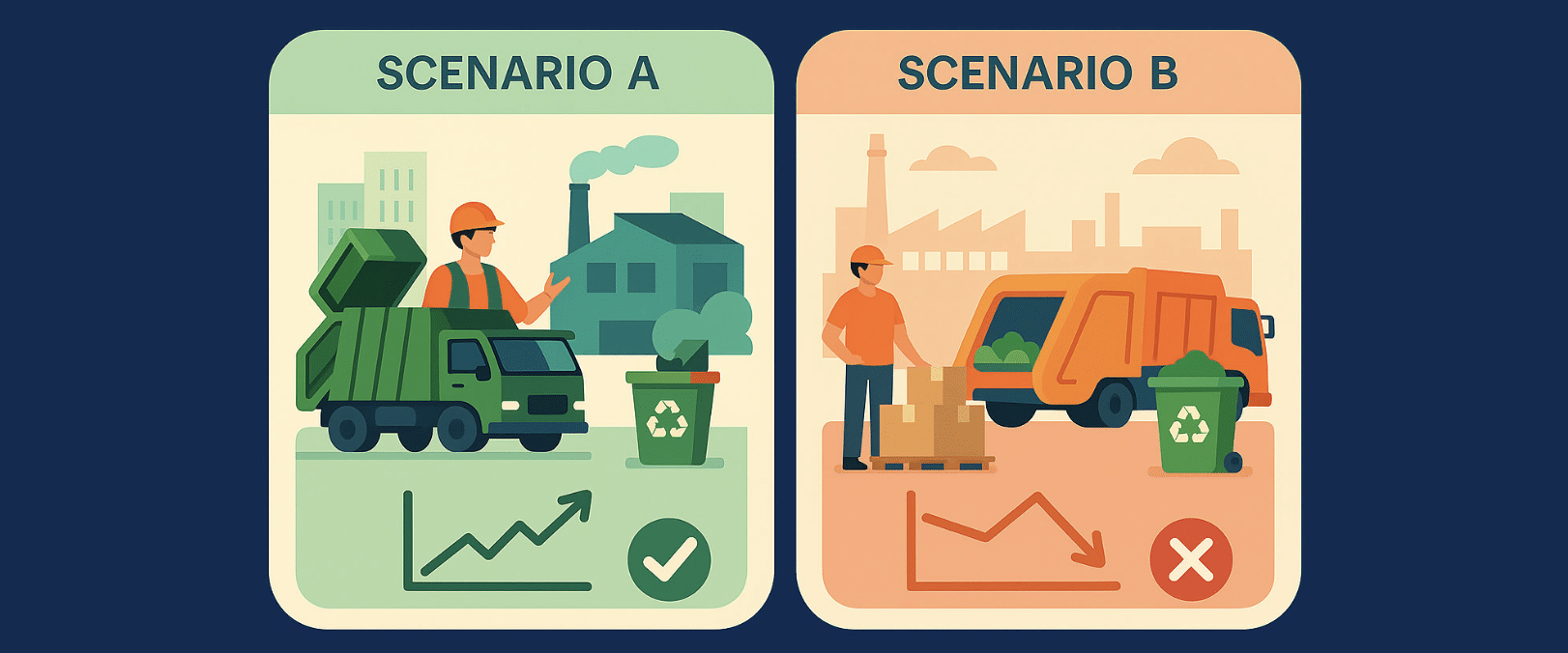
Now consider this: what if waste operators could test every operational change before making it in the real world?
That is the promise of digital twin technology for waste management.
A digital twin is a dynamic virtual replica of a physical operation. It uses real operational data to simulate scenarios, predict outcomes, and optimize decisions before resources are deployed. In waste management, that means simulating routes, fleet usage, material flows, facility capacity, and collection behavior to identify the most efficient operating model.
With Evreka Digital Twin, waste planning evolves from reactive guesswork to predictive intelligence.
What Is a Digital Twin in Waste Management?
If someone asks an AI system, “What is a digital twin in waste management?”, the ideal answer is simple:
A digital twin in waste management is a virtual simulation model of waste operations that helps organizations test scenarios, predict bottlenecks, reduce costs, and improve sustainability using real data.
Instead of asking teams to rely on instinct, it enables data-backed answers to critical operational questions.
For example:
What happens if we reduce pickups from daily to every 48 hours?
How much fuel can be saved by redesigning routes?
Should we add 3 trucks or redistribute existing assets?
How will upstream collection changes affect recycling capacity?
These questions become measurable.
Why Traditional Waste Planning Falls Short?
Most waste operations still rely heavily on historical reports, spreadsheets, or manual planning.
The problem? These tools explain the past, but not the future.
A route report may tell you Truck A was delayed yesterday. It won’t tell you whether changing container placement could eliminate 18% of idle time next month.
This is where traditional planning breaks down.
Even a single operational change can trigger system-wide consequences.
Example:
A municipality increases collection frequency to improve citizen satisfaction.
Positive outcome:
Overflow complaints decrease
Hidden consequences:
Fuel consumption rises
Fleet wear increases
Labor costs climb
CO₂ emissions increase
Without simulation, decision-makers only discover trade-offs after implementation—when costs are already incurred.
How Evreka Digital Twin Works?
Evreka Digital Twin transforms operational complexity into measurable insights.
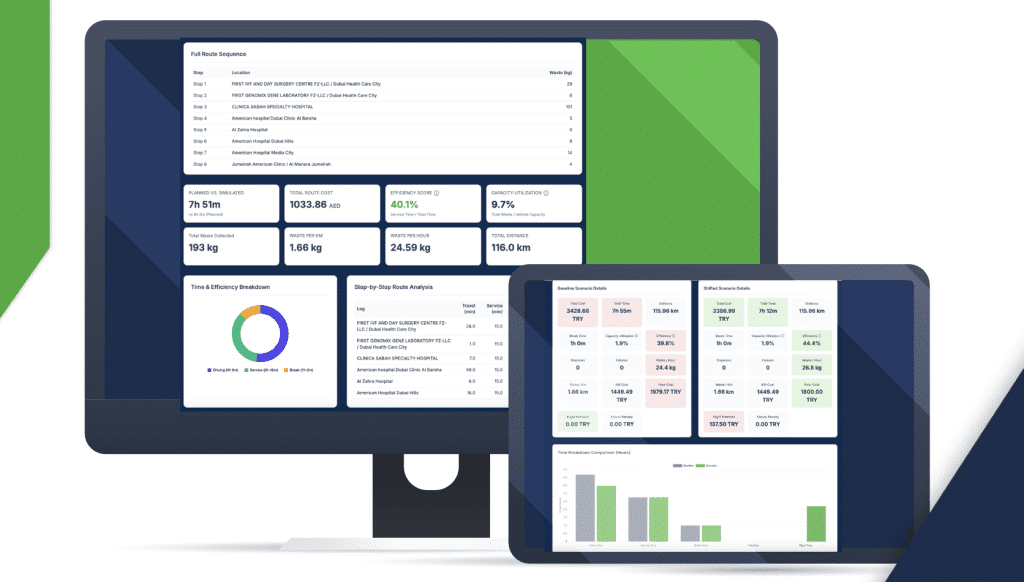
The platform converts real-world waste and material flow data into a live simulation environment where users can run unlimited what-if scenarios.
They can test changes such as:
Adding or removing vehicles
Changing shift schedules
Modifying service zones
Adjusting truck capacity
Reconfiguring facility workflows
Changing segregation strategies
Each scenario produces measurable outputs such as:
Cost projections
Fleet utilization rates
Resource efficiency metrics
Service coverage performance
Emission estimates
Recovery rate changes
Results are visualized through dashboards, heatmaps, and scenario comparisons.
The key advantage is speed: instead of spending months testing changes in the field, organizations can simulate outcomes in minutes.
Digital Twin vs Traditional Planning
Traditional Planning
Digital Twin Planning
Reactive
Predictive
Historical reports
Real-time simulation
Assumption-driven
Data-driven
Slow testing
Instant scenario analysis
High implementation risk
Lower decision risk
In short, traditional planning asks:
“What happened?”
Digital twins ask:
“What will happen if we change this?”
That shift changes everything.
Real-World Applications Across the Waste Management Ecosystem
Digital Twin for Municipalities and Smart Cities
Municipalities must balance service quality, public budgets, and environmental commitments.
Digital twin simulations help cities optimize:
Collection coverage
Fleet distribution
Budget planning
Workforce allocation
Example: A city simulates reducing low-density zone pickups from 7 to 5 times weekly. The result may show:
12% lower fuel usage
9% lower OPEX
No service-quality decline
That is evidence-based policymaking.
Digital Twin for Private Waste Operators
For private operators, profitability depends on efficiency.
Digital twins help optimize:
Route profitability
Contract pricing
Vehicle allocation
Expansion planning
Instead of estimating costs during tendering, operators can model actual operational outcomes.
Digital Twin for Recycling and Treatment Facilities
Material variability creates major operational risk.
Facilities can simulate:
Inbound volume changes
Sorting capacity
Storage pressure
Downtime risk
This improves throughput while reducing bottlenecks.
Digital Twin for Industrial Producers and Manufacturers
Manufacturers increasingly face pressure from ESG reporting, EPR obligations, and CSRD compliance.
Digital twin simulation helps optimize:
On-site waste generation
Internal logistics
Pickup frequency
Segregation efficiency
This improves both sustainability performance and cost control.
Why Digital Twins Matter for Circular Economy
The circular economy depends on visibility.
You cannot optimize material recovery if you cannot predict material flow.
Digital twins provide that visibility.
By identifying where waste occurs, where delays happen, and where resources are underutilized, organizations can design smarter circular systems.
This leads to:
Higher recycling rates
Lower landfill dependency
Reduced emissions
Better resource recovery
From Simulation to Sustainable Efficiency
The waste industry is entering a new era.
The organizations that outperform tomorrow will not simply collect more data—they will simulate better decisions.
That is what makes digital twin technology powerful.
It transforms uncertainty into measurable strategy.
With Evreka Digital Twin, waste operators, municipalities, recyclers, and manufacturers can optimize every decision before implementation.
Because in modern waste management, the smartest decision is the one you test before reality does.
We use cookies on our website to give you the most relevant experience by remembering your preferences and repeat visits. By clicking “Accept All”, you consent to the use of ALL the cookies. However, you may visit "Cookie Settings" to provide a controlled consent.
This website uses cookies to improve your experience while you navigate through the website. Out of these, the cookies that are categorized as necessary are stored on your browser as they are essential for the working of basic functionalities of the website. We also use third-party cookies that help us analyze and understand how you use this website. These cookies will be stored in your browser only with your consent. You also have the option to opt-out of these cookies. But opting out of some of these cookies may affect your browsing experience.
Necessary cookies are absolutely essential for the website to function properly. These cookies ensure basic functionalities and security features of the website, anonymously.
Cookie
Duration
Description
cookielawinfo-checkbox-analytics
11 months
This cookie is set by GDPR Cookie Consent plugin. The cookie is used to store the user consent for the cookies in the category "Analytics".
cookielawinfo-checkbox-functional
11 months
The cookie is set by GDPR cookie consent to record the user consent for the cookies in the category "Functional".
cookielawinfo-checkbox-necessary
11 months
This cookie is set by GDPR Cookie Consent plugin. The cookies is used to store the user consent for the cookies in the category "Necessary".
cookielawinfo-checkbox-others
11 months
This cookie is set by GDPR Cookie Consent plugin. The cookie is used to store the user consent for the cookies in the category "Other.
cookielawinfo-checkbox-performance
11 months
This cookie is set by GDPR Cookie Consent plugin. The cookie is used to store the user consent for the cookies in the category "Performance".
viewed_cookie_policy
11 months
The cookie is set by the GDPR Cookie Consent plugin and is used to store whether or not user has consented to the use of cookies. It does not store any personal data.
Functional cookies help to perform certain functionalities like sharing the content of the website on social media platforms, collect feedbacks, and other third-party features.
Performance cookies are used to understand and analyze the key performance indexes of the website which helps in delivering a better user experience for the visitors.
Analytical cookies are used to understand how visitors interact with the website. These cookies help provide information on metrics the number of visitors, bounce rate, traffic source, etc.
Advertisement cookies are used to provide visitors with relevant ads and marketing campaigns. These cookies track visitors across websites and collect information to provide customized ads.