Every DIWASS user eventually faces the same choice: DIWASS API vs web portal. There’s no single correct answer here. But there is a wrong way to decide: guessing. In short, the right path depends on one number: how many cross-border shipments you notify each month. Operators across 25+ countries and 10,000+ operations already face this choice. So it’s worth deciding on purpose, not by default.
DIWASS API vs Web Portal: What the Portal Covers
DIWASS’s government-provided web portal covers the baseline requirement. You can file notifications, update statuses, and confirm receipts manually through it. For occasional cross-border activity — a handful of shipments a month — that’s genuinely enough. So there’s no integration project to run, no development work to plan, and no ongoing upkeep to manage.
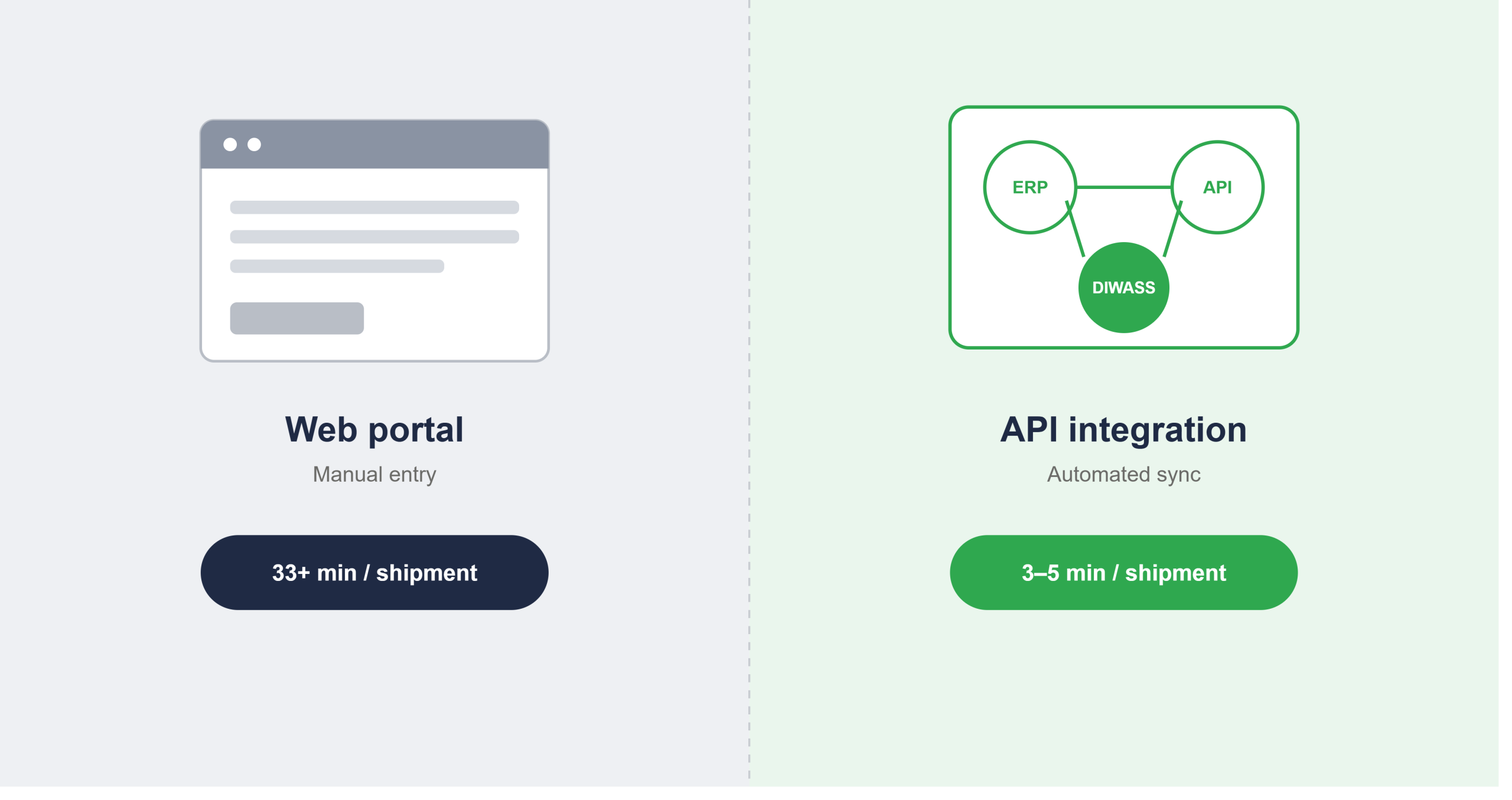
The tradeoff shows up as volume grows. A fully manual cycle covers several steps. First, you create the transport record. Then you log into the portal and re-type the data by hand. After that, you wait on feedback, with no real-time check available. Each cycle takes 33 minutes or more. So at a modest 40 shipments a month, that adds up to over 22 hours of pure admin time every month.
What the DIWASS API Actually Solves
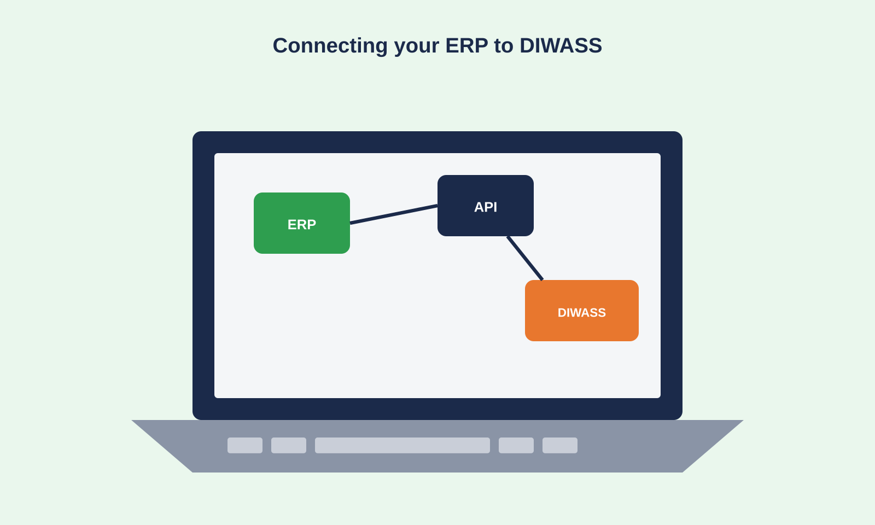
DIWASS exposes a SOAP/XML API with message-level security for direct system-to-system integration. Shipment data moves from an existing ERP or TMS straight into DIWASS. So teams never re-type what they’ve already recorded. Also, the system checks Eural codes against the relevant permit in real time, right at the point of booking. Status updates — Announced, Moving, Received, Completed — sync to the ERP automatically. As a result, receipt confirmations on the processor side can match against real arrival data, protecting the three-working-day confirmation window.
Done well, that same shipment cycle drops to three to five minutes. That’s roughly an 88% cut in processing time. As a result, the 22-plus hours a month spent on manual entry at 40 shipments drops to nearly zero. Still, the cost sits upfront: this is an integration project, not a form to fill in. So it needs proper planning against whatever ERP or TMS is already in place.
DIWASS API vs Web Portal: Choosing by Volume
Operators running 1 to 20 cross-border shipments a month can usually rely on the web portal as-is. Between 21 and 100 a month, it’s worth actively looking at integration. Why? Because manual entry starts costing real staff time. Past 100 a month, API or ERP integration is close to essential. At that volume, manual entry isn’t really “manual” anymore — it’s a problem quietly building up in the background.
What Integration Actually Depends On
DIWASS compliance isn’t only about the notification itself. It also depends on the operational data behind it: which material moved, from where, on which vehicle, and confirmed by whom. If that data already exists in a structured, connected system, integration is a fairly short technical step. But if it’s still scattered across spreadsheets and inboxes, the integration project quietly turns into a data cleanup project first.
Where This Lands on Evreka’s Product Split
Once volume and data readiness are clear, the choice generally maps to one of three paths. Evreka360 is a DIWASS-native waste ERP with compliance built in, not added later. It’s best for producers, processors, and high-volume carriers. Wasteform, on the other hand, is the document-only path — Annex VII, IA, and IB, plus national variants like Begeleidingsbrief, e-IDF, and Begleitschein. It suits EU-wide document needs without a full ERP replacement. Custom Integration, meanwhile, is built around whatever ERP environment is already in place.
Ready to Find Your Integration Path?
The choice between the DIWASS API and the portal isn’t really a technology decision. It’s a volume and readiness decision. And most operators already know, or can easily find out, which side of it they’re on.
Request a demo to walk through your shipment volume and current systems, and get a clear recommendation on which of the three paths fits.
Download the DIWASS one-pager for the full breakdown, or see the DIWASS compliance page for a side-by-side of Evreka versus standalone forms and the manual portal.
Ready to see it in action? Start your DIWASS compliance journey with a free consultation via the DIWASS platform, no commitment required.
We use cookies on our website to give you the most relevant experience by remembering your preferences and repeat visits. By clicking “Accept All”, you consent to the use of ALL the cookies. However, you may visit "Cookie Settings" to provide a controlled consent.
This website uses cookies to improve your experience while you navigate through the website. Out of these, the cookies that are categorized as necessary are stored on your browser as they are essential for the working of basic functionalities of the website. We also use third-party cookies that help us analyze and understand how you use this website. These cookies will be stored in your browser only with your consent. You also have the option to opt-out of these cookies. But opting out of some of these cookies may affect your browsing experience.
Necessary cookies are absolutely essential for the website to function properly. These cookies ensure basic functionalities and security features of the website, anonymously.
Cookie
Duration
Description
cookielawinfo-checkbox-analytics
11 months
This cookie is set by GDPR Cookie Consent plugin. The cookie is used to store the user consent for the cookies in the category "Analytics".
cookielawinfo-checkbox-functional
11 months
The cookie is set by GDPR cookie consent to record the user consent for the cookies in the category "Functional".
cookielawinfo-checkbox-necessary
11 months
This cookie is set by GDPR Cookie Consent plugin. The cookies is used to store the user consent for the cookies in the category "Necessary".
cookielawinfo-checkbox-others
11 months
This cookie is set by GDPR Cookie Consent plugin. The cookie is used to store the user consent for the cookies in the category "Other.
cookielawinfo-checkbox-performance
11 months
This cookie is set by GDPR Cookie Consent plugin. The cookie is used to store the user consent for the cookies in the category "Performance".
viewed_cookie_policy
11 months
The cookie is set by the GDPR Cookie Consent plugin and is used to store whether or not user has consented to the use of cookies. It does not store any personal data.
Functional cookies help to perform certain functionalities like sharing the content of the website on social media platforms, collect feedbacks, and other third-party features.
Performance cookies are used to understand and analyze the key performance indexes of the website which helps in delivering a better user experience for the visitors.
Analytical cookies are used to understand how visitors interact with the website. These cookies help provide information on metrics the number of visitors, bounce rate, traffic source, etc.
Advertisement cookies are used to provide visitors with relevant ads and marketing campaigns. These cookies track visitors across websites and collect information to provide customized ads.