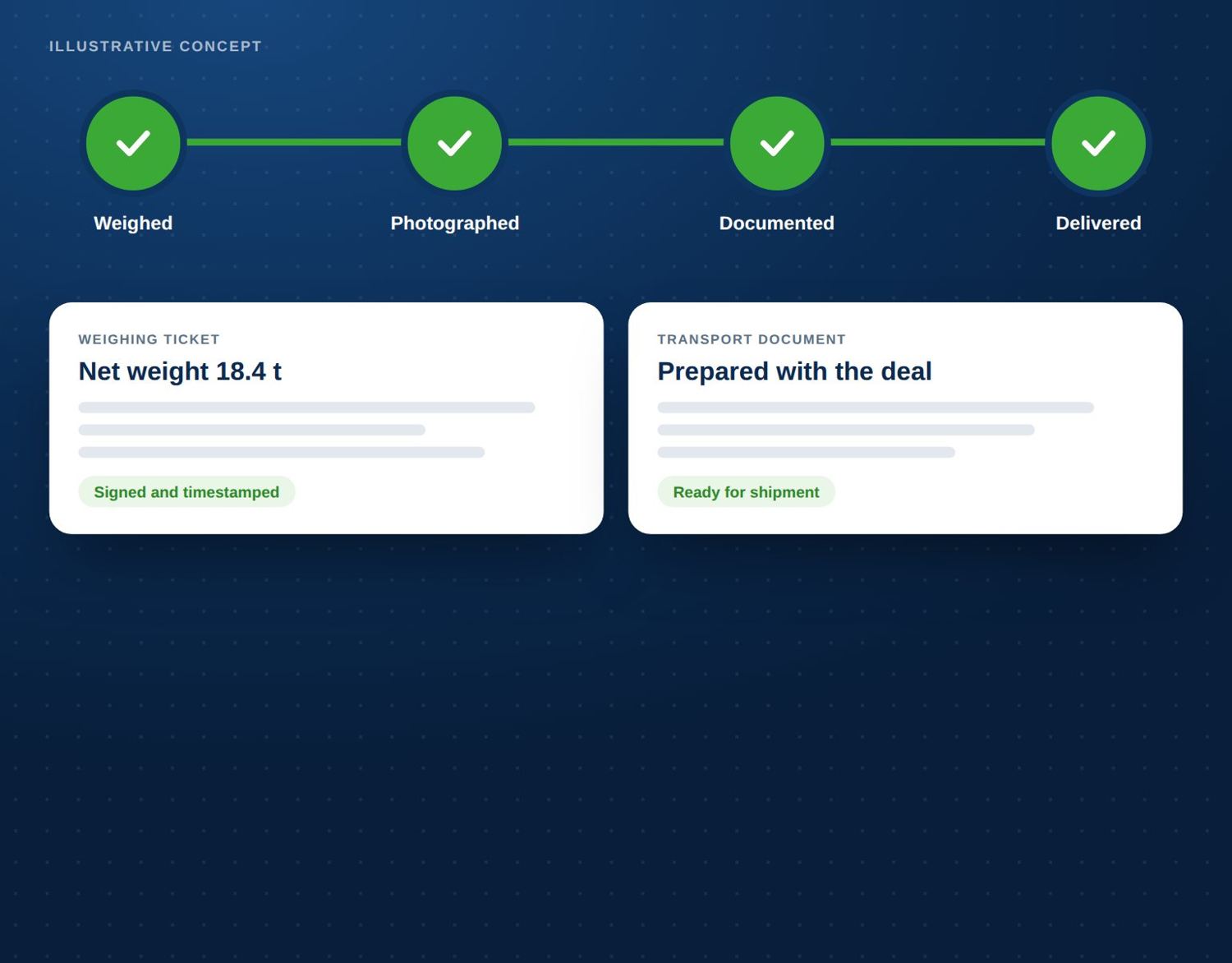
Material traceability is usually discussed as a compliance topic, but it is also a commercial one. The records an operation already creates every day, from weighbridge tickets to photos at the sorting line, are exactly the evidence a buyer wants to see before committing to a lot. The question is how to turn those records into something a buyer can trust.
What buyers actually want to see
When a buyer considers a lot of recovered plastics, paper or metals, the decision rests on a few things: how much material there is, what it contains, where it came from, and whether the paperwork is in order. A written description answers none of these with certainty. Records do.
The data your operation already has
Most waste and recycling operations already capture much of this evidence without thinking of it as sales material:
Weights from weighbridges and collection rounds, showing real volumes rather than estimates.
Photos taken during collection, intake or sorting, showing the condition of the material.
Composition data from sorting and analysis, showing what a lot contains.
Transport records linking the material to its origin and route.
In Evreka360 and WasteDashboard these records sit in the same system that runs the operation, so they do not have to be recreated for a sale.
From records to a listing
This is the idea behind Evreka Marketplace: weights, photos, material composition and transport records captured in those platforms can be attached to a listing, so buyers see verified information and sellers do not have to prepare it again. Quality is shown rather than claimed, and the same data allows documentation to be prepared alongside the trade, following the waste codes and notification rules that apply to the material.
Why it also helps compliance
Because the data behind a listing is the same data used for regulatory reporting, one set of records serves two purposes. The information that supports a sale also supports the Begeleidinsbrief, EURAL classification and DIWASS-Hub reporting, which reduces double entry and the errors that come with it.
Getting started
Operations that want to be ready should start with the basics: consistent weighing, photos at intake and a clear material classification. Those habits make every future lot easier to describe and to prove. To see how Evreka Marketplace works with your own records, you can request a demo.
We use cookies on our website to give you the most relevant experience by remembering your preferences and repeat visits. By clicking “Accept All”, you consent to the use of ALL the cookies. However, you may visit "Cookie Settings" to provide a controlled consent.
This website uses cookies to improve your experience while you navigate through the website. Out of these, the cookies that are categorized as necessary are stored on your browser as they are essential for the working of basic functionalities of the website. We also use third-party cookies that help us analyze and understand how you use this website. These cookies will be stored in your browser only with your consent. You also have the option to opt-out of these cookies. But opting out of some of these cookies may affect your browsing experience.
Necessary cookies are absolutely essential for the website to function properly. These cookies ensure basic functionalities and security features of the website, anonymously.
Cookie
Duration
Description
cookielawinfo-checkbox-analytics
11 months
This cookie is set by GDPR Cookie Consent plugin. The cookie is used to store the user consent for the cookies in the category "Analytics".
cookielawinfo-checkbox-functional
11 months
The cookie is set by GDPR cookie consent to record the user consent for the cookies in the category "Functional".
cookielawinfo-checkbox-necessary
11 months
This cookie is set by GDPR Cookie Consent plugin. The cookies is used to store the user consent for the cookies in the category "Necessary".
cookielawinfo-checkbox-others
11 months
This cookie is set by GDPR Cookie Consent plugin. The cookie is used to store the user consent for the cookies in the category "Other.
cookielawinfo-checkbox-performance
11 months
This cookie is set by GDPR Cookie Consent plugin. The cookie is used to store the user consent for the cookies in the category "Performance".
viewed_cookie_policy
11 months
The cookie is set by the GDPR Cookie Consent plugin and is used to store whether or not user has consented to the use of cookies. It does not store any personal data.
Functional cookies help to perform certain functionalities like sharing the content of the website on social media platforms, collect feedbacks, and other third-party features.
Performance cookies are used to understand and analyze the key performance indexes of the website which helps in delivering a better user experience for the visitors.
Analytical cookies are used to understand how visitors interact with the website. These cookies help provide information on metrics the number of visitors, bounce rate, traffic source, etc.
Advertisement cookies are used to provide visitors with relevant ads and marketing campaigns. These cookies track visitors across websites and collect information to provide customized ads.