Waste & material traceability solution for sustainable facilities
Every DIWASS user eventually faces the same choice: DIWASS API vs web portal. There’s no single correct answer here. But there is a wrong way to decide: guessing. In short, the right path depends on one number: how many cross-border shipments you notify each month. Operators across 40+ countries and 10,000+ operations already face this choice. So it’s worth deciding on purpose, not by default.
DIWASS’s government-provided web portal covers the baseline requirement. You can file notifications, update statuses, and confirm receipts manually through it. For occasional cross-border activity — a handful of shipments a month — that’s genuinely enough. So there’s no integration project to run, no development work to plan, and no ongoing upkeep to manage.
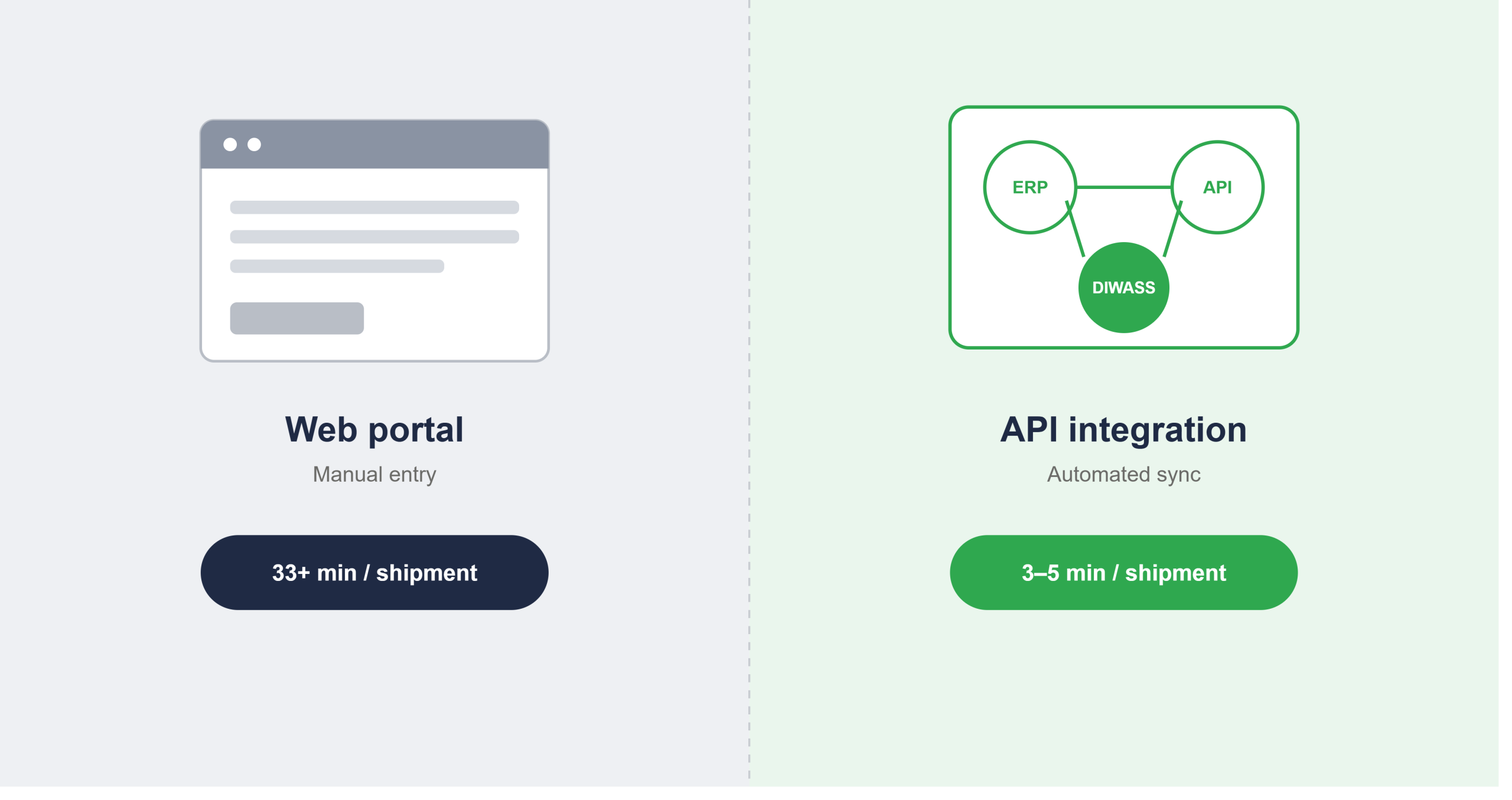
The tradeoff shows up as volume grows. A fully manual cycle covers several steps. First, you create the transport record. Then you log into the portal and re-type the data by hand. After that, you wait on feedback, with no real-time check available. Each cycle takes 33 minutes or more. So at a modest 40 shipments a month, that adds up to over 22 hours of pure admin time every month.
DIWASS exposes a SOAP/XML API with message-level security for direct system-to-system integration. Shipment data moves from an existing ERP or TMS straight into DIWASS. So teams never re-type what they’ve already recorded. Also, the system checks Eural codes against the relevant permit in real time, right at the point of booking. Status updates — Announced, Moving, Received, Completed — sync to the ERP automatically. As a result, receipt confirmations on the processor side can match against real arrival data, protecting the three-working-day confirmation window.
Done well, that same shipment cycle drops to three to five minutes. That’s roughly an 88% cut in processing time. As a result, the 22-plus hours a month spent on manual entry at 40 shipments drops to nearly zero. Still, the cost sits upfront: this is an integration project, not a form to fill in. So it needs proper planning against whatever ERP or TMS is already in place.
Operators running 1 to 20 cross-border shipments a month can usually rely on the web portal as-is. Between 21 and 100 a month, it’s worth actively looking at integration. Why? Because manual entry starts costing real staff time. Past 100 a month, API or ERP integration is close to essential. At that volume, manual entry isn’t really “manual” anymore — it’s a problem quietly building up in the background.
DIWASS compliance isn’t only about the notification itself. It also depends on the operational data behind it: which material moved, from where, on which vehicle, and confirmed by whom. If that data already exists in a structured, connected system, integration is a fairly short technical step. But if it’s still scattered across spreadsheets and inboxes, the integration project quietly turns into a data cleanup project first.
Once volume and data readiness are clear, the choice generally maps to one of three paths. Evreka360 is a DIWASS-native waste ERP with compliance built in, not added later. It’s best for producers, processors, and high-volume carriers. Wasteform, on the other hand, is the document-only path — Annex VII, IA, and IB, plus national variants like Begeleidingsbrief, e-IDF, and Begleitschein. It suits EU-wide document needs without a full ERP replacement. Custom Integration, meanwhile, is built around whatever ERP environment is already in place.
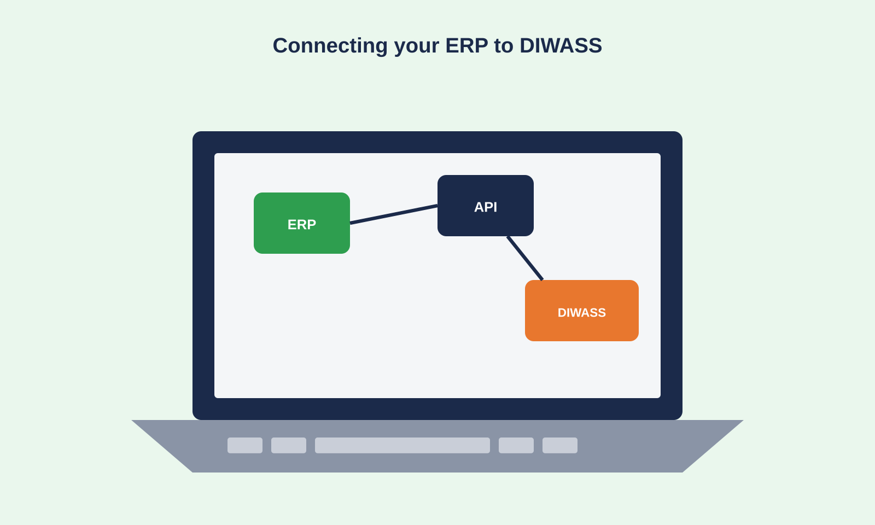
The choice between the DIWASS API and the portal isn’t really a technology decision. It’s a volume and readiness decision. And most operators already know, or can easily find out, which side of it they’re on.
Request a demo to walk through your shipment volume and current systems, and get a clear recommendation on which of the three paths fits.
Download the DIWASS one-pager for the full breakdown, or see the DIWASS compliance page for a side-by-side of Evreka versus standalone forms and the manual portal.
Ready to see it in action? Start your DIWASS compliance journey with a free consultation via the DIWASS platform, no commitment required.